Why Stories Change Each Time They Are Told
Why stories change each time they are told: compare three ways to retell family memories while keeping remembered detail distinct from later meaning.
Why stories change each time they are told is easier to see when two relatives remember the same kitchen, journey or family disagreement differently. A teller chooses which details to bring forward, and an audience changes what seems worth explaining. The account can shift without anyone deliberately making it up.
That distinction matters when a family wants to pass on a memory without turning one person’s interpretation into everybody’s fact. Retelling is not a faulty photocopier. It is a choice among several useful forms, each suited to a different purpose.
Three ways to retell
A memory can be told as a compact anecdote, as an open conversation, or as a layered account that separates recollection from later interpretation. These are not stages of increasing accuracy. They serve different listeners and different occasions.
- The anecdote gives a scene a clear shape and is easy to pass along.
- The conversation lets several memories sit alongside one another.
- The layered account preserves both what someone recalls and what they now think it meant.
Choose according to the job the story needs to do. A short tale can keep a family gathering lively; a more careful record is better when the question is what people remember and what they inferred later.
The compact anecdote
An anecdote selects a few details and gives them direction. A beginning establishes the situation, a telling moment carries the action, and an ending provides a reason to remember it. The shape is useful because listeners can follow it without a family tree and a map.
That shape also has a cost. Details that do not serve the point may fall away. A story about a relative calmly fixing a torn coat, for instance, might acquire a moral about resourcefulness. The needle, the poor light and the annoyance of the person wearing the coat could disappear, although those details may matter to someone who remembers the scene differently.
Use an anecdote when the aim is to share a memorable scene, not to settle every uncertainty around it. Keep an awkward or contradictory detail if it changes how the scene feels. Neatness is a poor substitute for memory.
The open conversation
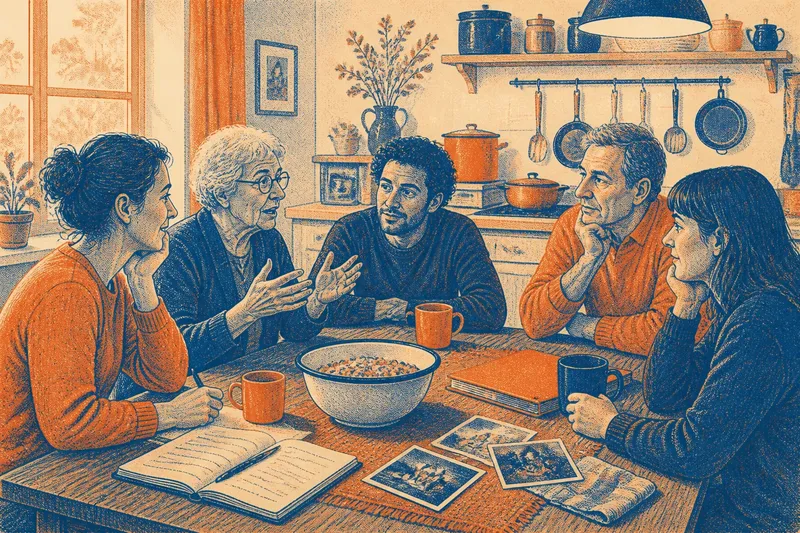
A conversation is better when several people have their own view of an event. Rather than asking one person to supply the definitive version, ask each teller what they remember noticing. One may recall the room; another, the words spoken; a third, what happened afterwards.
Questions should invite recollection rather than suggest an answer. “What do you remember about leaving?” leaves space. “Was everyone angry when they left?” supplies both the mood and the event before anyone has answered. A prompt can quietly become a script.
This approach suits families who want to hear differences while the people involved can still clarify their own accounts. It can be slower and less tidy than an anecdote. Allow someone to say they do not remember, or that another person may recall it differently.
The layered account
A layered account keeps the remembered scene apart from the meaning assigned to it later. It need not sound formal. The teller can say, “I remember the bus being nearly empty. At the time I thought my father was embarrassed; now I wonder if he was simply tired.” The first statement concerns a recalled detail. The second identifies an interpretation, including its uncertainty.
Say you are recording an invented family memory about a neighbour who brought a dish to a gathering. You recall the blue enamel bowl and that it arrived after supper; your cousin remembers it being served earlier. You might keep both accounts, mark the timing as disputed, and add that you now read the gesture as kindness. The result preserves the disagreement without forcing either person’s recollection to carry the later meaning.
This form suits a family history, an audio recording or a conversation where a memory may be repeated by people who were not present. It takes a little more care, but it makes room for change without disguising it as certainty.
Choosing a retelling?
How can I separate memory from interpretation?
Write or say the scene in one sentence, then give your explanation in another. Phrases such as “I remember” and “I think now” help mark the difference without pretending that memory is a transcript.
Should conflicting recollections be combined?
Not unless the tellers agree on a shared version. Keep distinct accounts beside each other and identify the point of disagreement in plain language.
What should I ask another teller?
Ask about a concrete part of the scene: what they noticed, where they were, or what happened next. Avoid questions that suggest a motive or emotion before the person supplies one.
Which approach suits a family recording?
Use a layered account if the recording is meant to preserve both recollection and reflection. Choose a compact anecdote for casual sharing, or a conversation when hearing different voices is the point.
Keep the seams visible
When a story is retold, selection is unavoidable; what matters is noticing where selection changes the account. A family may prefer a short anecdote for a meal and a layered version for a lasting record. Neither needs to cancel the other.
For why stories change each time they are told, listen for the seam between a remembered detail and the meaning added around it. That small distinction lets a story remain vivid without making interpretation impersonate evidence.