The Keepsake Box Does Not Have to Hold Everything
A keepsake box can preserve family meaning without storing every inherited object. Choose a few items with clear stories and give the rest a considered next use.
A keepsake box can preserve family meaning without holding every inherited object. Its contents matter less than whether someone can say what an item meant, who it belonged to and why it stayed. A box packed with things no one can identify is an archive of uncertainty, which is a rather demanding gift to leave the next person.
Imagine that Mara inherits a small wooden sewing box, a stack of recipe cards, several brooches, a chipped teacup and a bundle of handwritten notes from her grandmother. The family has already agreed that these things are “too meaningful to throw away”. That phrase settles nothing. Mara’s task is not to decide whether the past matters. It is to work out which objects can carry a story forward, and what should happen to the rest.
The inheritance on the table
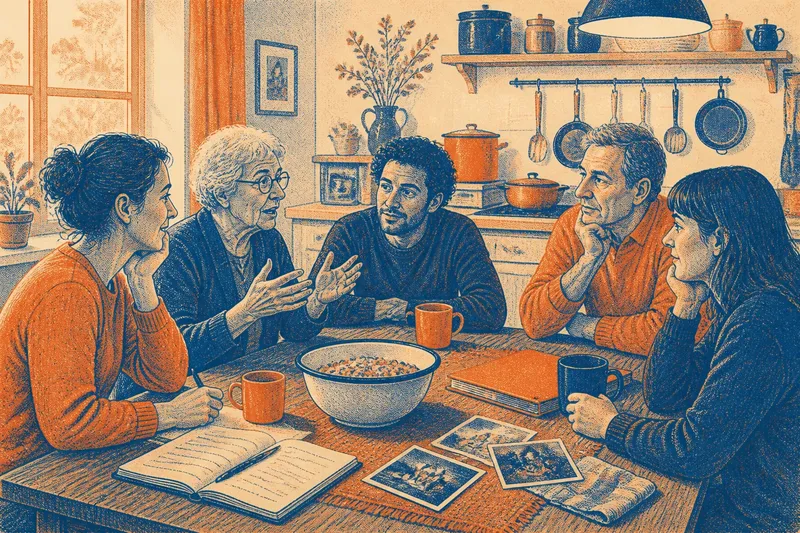
Mara begins by putting the objects where everyone can see them. She does not start with a box size, a storage purchase or a rule about keeping one item from each category. Those decisions would make the container the authority. Instead, she asks relatives to identify anything they recognise and to say what they know, including when they are unsure.
The first pass separates three kinds of information. One is directly visible: the teacup has a crack near the handle. One comes from a family account: an aunt remembers her grandmother using it at the kitchen table. The third is inference: someone thinks a particular brooch may have belonged to a great-aunt because it was found among her things. Keeping those distinctions clear prevents a plausible guess from quietly becoming family fact.
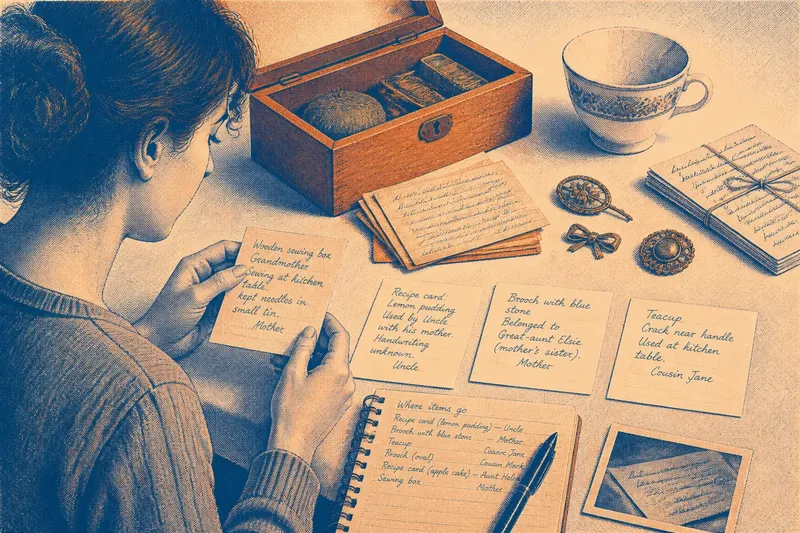
Mara writes short notes on separate paper, not on the objects. Each note gives an item’s name, the person associated with it and the source of the story. If the source is uncertain, the note says so. A label that reads “Grandmother’s brooch, perhaps from her sister” is more useful than a confident but unsupported name.
Begin with what the family can actually say, not what it hopes the object means.
Stories before selections
The sewing box draws the clearest account. Mara’s mother remembers borrowing it to mend a coat, and recalls that her grandmother kept needles in a small tin inside. Her cousin remembers the box appearing whenever a button came loose. The stories differ in detail but agree on the object’s use and its place in ordinary family life.
The recipe cards carry another kind of meaning. Several have corrections in the margins, written in different hands. Mara’s uncle recognises one card as the one he used to make a particular pudding with his mother. He cannot identify the handwriting on another. Rather than treating every card as a relic with a known author, Mara marks the identified card and records that the others’ writers are unknown.
The brooches are harder. One relative remembers a brooch being worn at family gatherings but cannot say which one. Another knows that a different brooch came from a relative who lived abroad, though the name has been lost. The objects may still matter, but their stories are thin. Mara does not improve them by inventing a more complete version.
The cracked teacup prompts a small disagreement. One cousin sees a familiar kitchen object; another sees a damaged cup with little practical use. Both responses are honest. The useful question is not whether the cup deserves universal affection, but whether anyone wants to care for it and can describe its connection to the family.
Choosing what can travel
Mara chooses the sewing box, the identified recipe card and one brooch that her mother recognises from a particular relative. She includes a concise note with each. The box’s note records the remembered repairs and the needle tin; the card’s note identifies the relative who cooked from it; the brooch’s note states who remembered it and what remains unknown.
This is not a ranking of love. A person may feel strongly about an item whose history is unclear, and another may know a detailed story without wanting the object. Mara asks who wants to keep each selected piece and whether that person can store it sensibly. An item kept by someone who has chosen it is more likely to remain accessible than one assigned to a reluctant custodian.
She also considers whether a photograph can preserve a useful detail without requiring the physical object to stay. A photograph of the handwriting on the recipe card, for instance, can sit with a copy of the note. It cannot replace the paper’s texture or the card’s place in family memory, but it can keep the words available if the original is later passed on. The photograph serves the story; it does not pretend to be the story in full.
For a selected object, keep its note close enough that it is unlikely to become separated.
Giving the others a next use
The remaining objects do not all have the same destination. Mara asks relatives whether they want any of them, without treating a refusal as an insult. Her aunt chooses a second recipe card because she intends to cook from it. A cousin asks for one brooch, not because he knows its history, but because he likes it and is willing to look after it. Mara writes down the handover so the family can tell where the object went.
The teacup stays with a relative who wants it on a shelf. That decision is practical and personal; it does not need to become a rule for every chipped cup. The uncertain brooches are offered to family members who may have a connection, then considered for donation if no one wants them. Items with no story and no willing custodian need not remain in the box merely because they arrived together.
Mara keeps the notes for objects that leave, including the recipient or destination where the family agrees this is useful. This gives later relatives a record of what happened without implying that every item has been preserved. Passing something on can be a deliberate act of care. Keeping it indefinitely is not the only evidence that it mattered.
What should happen to inherited objects?
How do you choose which keepsakes to keep?
Choose objects that someone wants to care for and can connect to a specific person, use or remembered occasion. The connection may be modest, but record who supplied it and what is known rather than filling gaps with assumption.
What if relatives disagree about an item?
Let each person explain their attachment before deciding who, if anyone, will keep it. If two people want the same object, a family agreement about shared custody, a temporary loan or a photograph may be more workable than pretending the disagreement is about its market or sentimental worth.
Can a photograph replace a family keepsake?
A photograph can preserve appearance, handwriting or a detail that might otherwise be forgotten. It cannot preserve the feel, use or full history of an object, so treat it as a useful record rather than an exact substitute.
What belongs in a keepsake box?
There is no required category or number of objects. A box can hold a few well-described items, their accompanying notes and perhaps copies of relevant photographs, provided the contents are kept in a condition suited to their materials.
A smaller box, a fuller account
By the end, Mara’s box is smaller, but its contents are easier to understand. Each selected object has a person willing to keep it and a note that separates memory from uncertainty. The family has also made a record of several objects that moved elsewhere. Nothing in the process proves that the chosen three are objectively the most important. It shows that they have been chosen with care.
The larger lesson is that an inherited object and the meaning attached to it are related, not identical. A story can survive through conversation, a written note, a shared recipe or a photograph, while an object can leave the family’s possession without erasing the memory. The keepsake box does not have to hold everything; it needs enough context for what remains to be understood.
If you are making a keepsake box, write the story before closing the lid. A later relative may not know which details mattered, but a clear note gives them somewhere to begin.