A Demonstration or a Written Sequence?
A demonstration or written sequence can preserve a hands-on skill in different ways. Use a short teaching plan to capture movement, order and useful cues.
A demonstration or written sequence preserves different parts of a hands-on skill. A person watching a neighbour sharpen a kitchen knife can see the angle of the blade; a person reading the steps later can check what comes before honing and what comes after. Neither method carries the whole skill by itself. The useful choice is not which one is better, but what a learner needs to notice and what the person passing it on can reliably record.
For a family skill, that distinction matters. Handing on a way to mend a torn hem, prepare a seedbed or fold pastry involves movement, judgement and order. A demonstration makes movement visible. A written sequence makes order easier to revisit. A modest plan spread over a week lets each do its proper work without turning a visit into a lecture or a notebook into an unreliable substitute for a person.
What Hands Reveal
A demonstration exposes information that is easy to omit from instructions. The learner sees where the hands begin, which tool is held firmly and which is allowed to move, and what changes when pressure is adjusted. They also see pauses: the moment a person checks a seam, tests a dough’s texture or listens for a particular sound.
These small cues often explain why a written verb such as “press” is not enough. Does the task call for a light touch or a firm one? Should the material yield, remain flat or spring back? A skilled person may answer without speaking, simply by changing their grip. The learner can ask about that adjustment while it is happening.
Watching also reveals the shape of a task as a whole. A person may lay out materials before beginning, move a tool out of reach during one stage, or check the work from a different angle. Those choices are part of the method, even if the person performing it no longer thinks of them as decisions.
Keep the first demonstration uninterrupted enough for the learner to understand the broad movement. Save detailed questions for a natural pause, such as when the person changes tools or inspects the result.
What Writing Preserves
A written sequence serves a different need: it gives the learner something to consult after the demonstration ends. It can preserve the order of operations, name materials and tools, and flag a point where people commonly move on too soon. Unlike a remembered performance, a note can be checked while the learner works alone.
Good notes record observable actions, not vague praise. “Work until it looks right” tells a reader little. “Check that the two edges meet without pulling the cloth” gives the learner something specific to inspect. If a decision depends on touch, sound or smell, name the cue and describe what it signals as plainly as possible.
Writing also helps expose gaps in a person’s own account. Someone who has completed a task for years may skip a preparation step because it feels obvious. Asking them to describe the order can bring that hidden step into view. The page is not merely a copy of spoken instructions; it is a prompt to notice what the expert has stopped noticing.
Use the notes to retain sequence and decision points, not to describe every movement in prose. A page dense with directions can be harder to use than a short list with room for a learner’s own observations.
A Week Of Practice
A simple week gives both methods room. It does not require formal lessons or a special recording device. A notebook, a pencil and the materials already used for the task will often do. Agree on one bounded skill, such as hemming a cotton tea towel, rather than a broad subject like sewing.
- Day one: watch. Ask the person who knows the skill to demonstrate it at an ordinary pace. The learner watches the full sequence first, then asks about any movement or decision that was hard to see.
- Day two: record the order. Together, write a short sequence using plain verbs. Note tools and materials, and mark any point where the learner should stop and inspect the work.
- Day three: try one section. The learner repeats a manageable part while the experienced person watches. The helper names a useful cue rather than taking over at the first awkward movement.
- Day four: add the missing cue. Compare what the learner expected with what happened. Add a note about pressure, alignment, texture or another visible or felt signal that changed the result.
- Day five: try from the page. The learner follows the sequence without a running explanation. Make a mark beside any instruction that proves unclear or arrives too late.
- Day six: revise and ask. The learner asks about the marked points. Update the notes so they answer a real question, not an imagined one.
- Day seven: repeat a small section. Try the task again and decide what remains easier to learn by watching. Keep the notes with the relevant tools or materials so they can be found when needed.
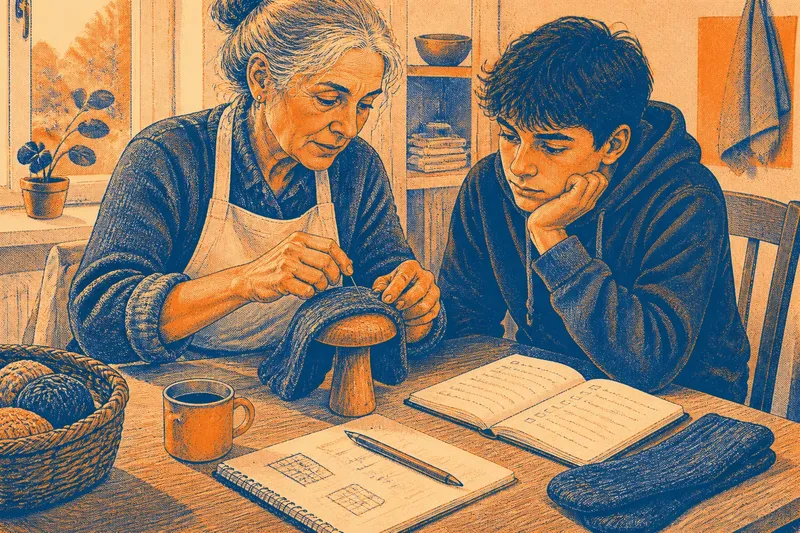
Say an aunt shows a nephew how she darns a woollen sock. On the first day, he notices that she turns the sock inside out before setting the darning mushroom beneath the hole. Their notes initially say only “weave the yarn across”. When he tries a small section later, he sees that his stitches pull the fabric tight. They add a cue about keeping the surrounding knit relaxed, then he watches her demonstrate the change in tension. The sequence now helps him find his place, while the demonstration explains a movement he could not describe precisely.
Which Method Fits?
Choose the emphasis according to what is hardest to recover later. A learner who forgets the order may benefit from a written sequence beside the work surface. A learner who understands the order but struggles with hand position may need another demonstration, preferably from an angle where the movement is clear.
Some skills ask for both from the start. A recipe can list when ingredients are added, while a demonstration can show what a dough looks and feels like before it is ready. A repair may have an exact sequence of materials but still depend on how gently the fabric is held. Treat that difference as useful information: the note can point to the moment where observation matters most.
When a person’s usual method relies on a special tool or material, record its name and purpose rather than silently substituting something else. For practical tasks, follow the relevant maker’s instructions and local rules where they apply; a family habit does not replace safety guidance.
Questions Learners Ask?
How do you write a skill that depends on touch?
Describe the cue the learner can notice, such as whether cloth lies flat or a mixture holds its shape. Pair that wording with a demonstration, since a sentence can point towards a sensation but cannot provide it.
Should the learner take notes during a demonstration?
Not if writing distracts them from seeing the hands clearly. Let them watch first, then jot down the sequence and ask the demonstrator to clarify uncertain points.
What if the person teaching cannot explain each movement?
Ask them to repeat a short section slowly and describe what they are checking as they go. Their hands may reveal a decision before they have a name for it.
How long should the written sequence be?
Long enough to preserve the order, tools and important checks, but short enough to consult while working. If it takes longer to decode than to ask a question, revise it.
Keep The Record Usable
Write for the person who will use the notes, not for an imagined archive. Give the task a clear name, list materials in familiar terms and separate actions from checks. If one step can be skipped only under certain conditions, state the condition. Otherwise a later learner may treat a choice as a rule or a rule as decoration.
Leave space for corrections. A learner may discover that “turn the cloth” needs a direction, or that a tool has a familiar family name and a different name on its packaging. Keep both names if that will help the next person find it. A handwritten note can carry context that a neat rewrite would accidentally remove.
Make a fresh demonstration part of the record when the work changes with the person doing it. A learner’s hands may differ in reach, strength or comfort. The aim is not to reproduce the teacher’s exact motions, but to pass on the purpose of each motion and help the learner find a workable version of it.
Keep the written sequence near the tools, and note which parts still need to be seen. A demonstration or written sequence is most useful when each makes the other easier to understand: one shows the moving detail, the other gives it a place in the task.