Before the Family Album: Ways People Kept a Record
Before the family album, people preserved recollections through spoken accounts, letters, diaries and labelled images, each leaving a different kind of record.
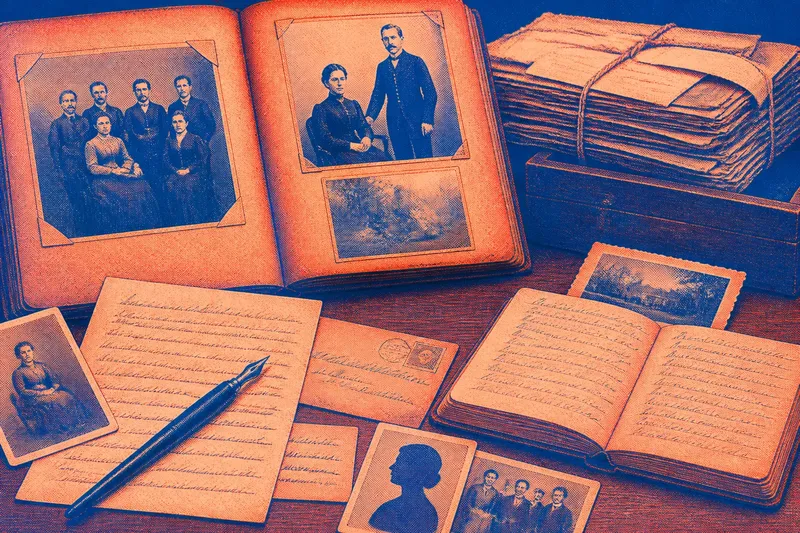
Before the family album, a family record might be a story repeated at the table, a letter folded into a drawer or a portrait kept with no name on its back. These forms did not simply lead towards the photograph album. Each preserved a different part of family life, and each left its own gaps for later generations to notice.
To understand how personal recollections were kept, it helps to separate the record from the memory it carries. A spoken account depends on a teller and a listener. A letter fixes words to a particular moment. An organised collection of images makes people visible, but may say little about who they were. The history of family records is less a march from imperfect to perfect than a change in what could be held, arranged and passed on.
Memory in company
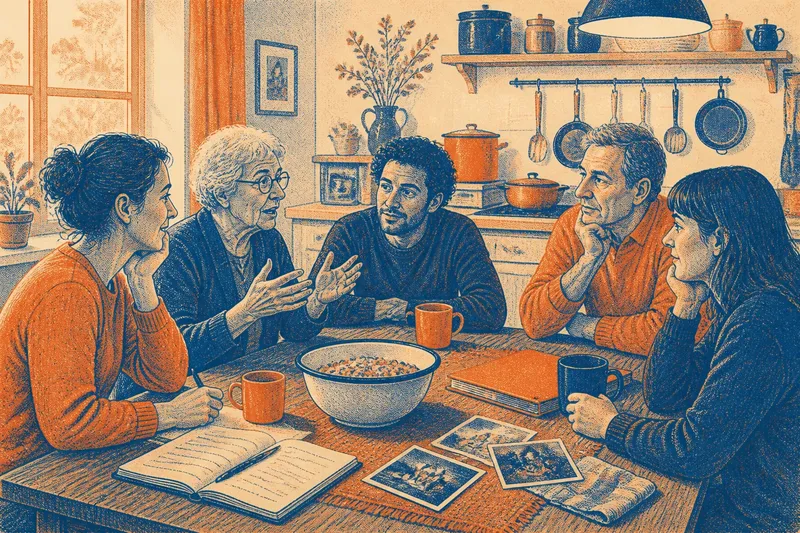
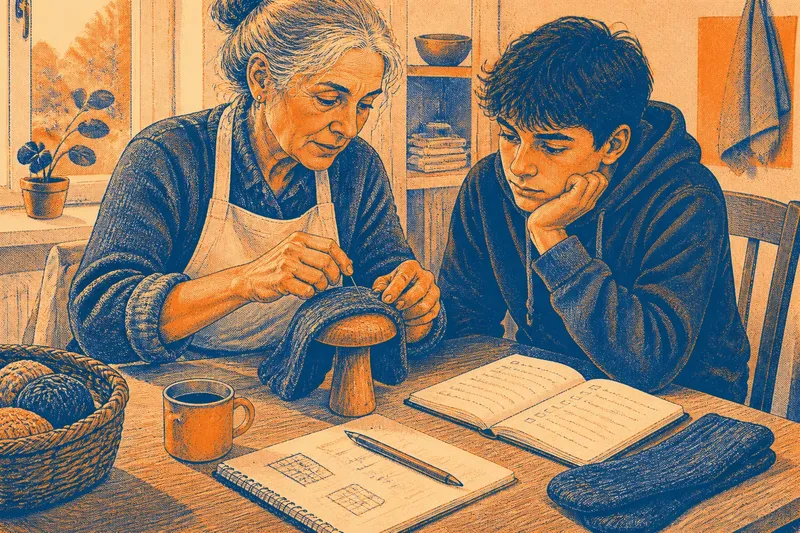
For much of family life, recollection travelled by voice. An older relative named a place, explained a relationship or described a household habit while doing something else. The account was not necessarily delivered as a formal story. It might arise while sorting tools, preparing food or correcting a child’s assumption about a person in a portrait.
Spoken memory has a particular strength: it can respond. A listener can ask who was present, what a room looked like or why a particular object mattered. A teller can adjust the account to the listener’s age and knowledge. Family recollection therefore often grew through conversation rather than through a single authorised version.
Its weakness is equally plain. A conversation may leave no durable trace, and a detail can disappear when nobody thinks to ask about it. Even a vivid account usually relies on a person who remembers it, and that person may be the only one who knows a name, place or sequence of events. The record exists, but it remains attached to a living exchange.
Some communities and households developed ways of carrying knowledge through repeated recitation, shared sayings or accounts linked to particular places and occasions. The form varied with language, custom and circumstances. It need not resemble a written family history to perform a similar task: placing people and events within a remembered order.
Words fixed on paper
Writing changed the conditions of keeping a recollection. A letter could preserve a person’s own phrasing, the concerns of a particular day and the practical details that a later family history might omit. A diary or notebook could hold observations for an audience of one, sometimes with no intention that anyone else would read it.
Such papers are not neutral containers. A letter is shaped by its recipient. A diary is shaped by what the writer chose to record, avoid or assume would be obvious later. A household account book may identify a purchase but not explain why it mattered. The ordinary paper trail can preserve the texture of a life precisely because it was made for purposes other than remembrance.
Keeping documents also depended on material circumstances. Paper had to remain somewhere dry and safe enough to be found again. A letter might be tied in a bundle, placed in a writing desk or carried when a household moved. These arrangements could preserve one kind of record while losing another. A tidy packet of correspondence might survive, while casual notes were used for kindling or discarded as clutter.
Handwriting, spelling and shorthand can make old papers hard to read. Names may appear in several forms, and a familiar place may have been described by a local term rather than its official one. A record can be legible to its maker and opaque to everyone else. Marginal notes and envelopes sometimes supply context that the main page leaves out.
Images with thin captions
Portraits and other images made a different claim. They could preserve a face, a pose, a room or a group’s arrangement in a way that words could not. A photograph could be passed from one household to another and recognised by people who had never met the person pictured. But visibility was not the same as identification.
An image without a name or date can become an attractive puzzle. The clothing, furniture and setting may offer clues, but a clue is not a family account. A later viewer might know that a photograph shows a wedding and still not know which couple, where the gathering took place or who stood beyond the frame. The photograph keeps appearances while leaving relationships to be supplied elsewhere.
Before photographs became easy to make and keep, painted portraits, silhouettes and printed images could also serve as family records. They were often costly or deliberately composed, so they represented a narrower slice of life than a casual snapshot. Their value lay partly in the act of commissioning or preserving them: a family chose that likeness to stand for someone beyond the moment of looking.
Images became more useful as records when people added names, dates or other identifying notes. A caption might be written on a mount, on the reverse of a print or on a separate slip kept with it. Each method carried a risk: the note could be mistaken, detached or separated from the image. The modest inscription often does more for a future relative than a carefully chosen frame.
Collections change the record
An organised collection does more than gather surviving objects. It creates relationships among them. When a person puts letters in date order, groups portraits by household or labels a stack of prints, they offer a way to read the material. Their arrangement can make connections visible, but it can also conceal the reason an item was kept.
Family albums made this ordering visible. Pages could join images into a sequence: a set of relatives, a journey, a new home or the growth of a household. The page offered a compact account, even when no captions explained it. Empty spaces, copied prints and abrupt changes in subject may all reflect practical decisions rather than a deliberate narrative.
An album is also selective. Someone chose which images earned a place and which remained loose or were discarded. A collection may favour formal occasions, particular branches of a family or people whose names were known. The resulting record can feel coherent while representing only the portion of life that someone had the means and inclination to preserve.
Say you inherit an album whose first pages show several unnamed adults in a front room. You could compare the faces with labelled portraits kept elsewhere, then write a pencil note on a separate archival slip rather than mark the photograph. The useful result would not be a solved family mystery by decree; it would be a clearly recorded identification, with its source and any remaining uncertainty kept alongside the image.
How do old records fit together?
What counts as a family record?
A family record is any surviving trace that helps identify people, relationships, places or experiences. It may be a formal document, a private letter, a photograph, a household object with an inscription or an account retained in speech. Its usefulness depends on what it preserves and what context remains.
Why do written records leave gaps?
Writers recorded what seemed necessary or worth saying at the time, not everything a later reader might want to know. A note may identify a payment but omit the person who made it, while a letter assumes its recipient already knows the family relationships. Missing context is part of the document’s original circumstances, not evidence that nothing happened.
How can an unnamed photograph be understood?
Look for information that can be checked against other surviving material: inscriptions, associated letters, album order and names attached to related portraits. Keep an uncertain identification distinct from a confirmed one, and record why a proposed name seems plausible. Guessing becomes less troublesome when it is visibly marked as a guess.
Do albums tell a complete story?
No. An album records choices about which images to print, keep and arrange, as well as the events shown in them. It is a strong source for some visual details and a weak guide to the lives that were left outside the frame.
Reading what remains
Records from different periods and households are rarely interchangeable. A spoken account can explain why an object mattered; a letter can preserve the writer’s immediate concerns; an image can show a face or setting; an album can reveal how someone arranged a family in memory. Reading them together makes it possible to ask better questions without pretending that one form supplies every answer.
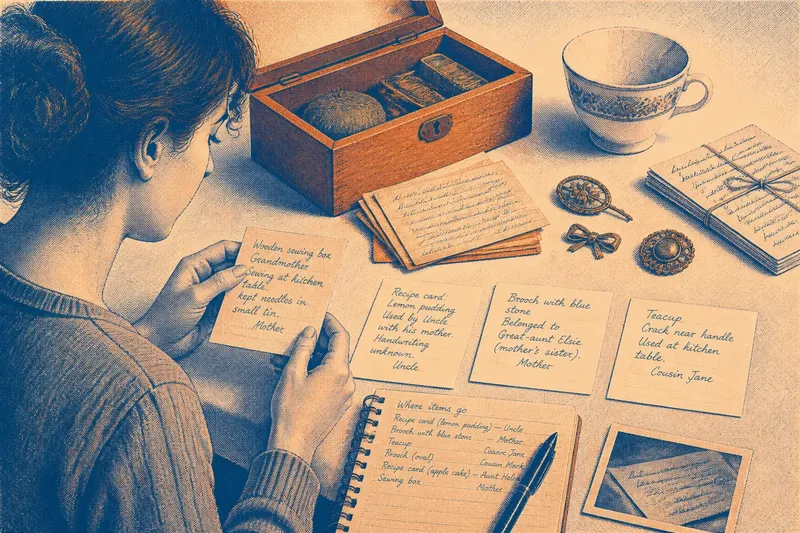
When handling inherited material, preserve the information attached to it before making a new arrangement. Keep envelopes with their letters, note where loose photographs were found and avoid writing on delicate originals. For an image whose identity is uncertain, use a separate note that distinguishes an observation from an assumption. These small records help later readers understand not only the item, but the current state of knowledge about it.
There is no need to turn every surviving paper or image into a polished family narrative. Some records are fragmentary because the lives they came from were busy, private or simply not arranged for future readers. The practical value of learning how people kept a record before the family album is that it changes what counts as evidence: a name on an envelope, a repeated account and a carefully ordered page each preserve a different part of the past.